

APAD 124: Buddhist temple entrance
Sorry if I sound a bit like Indiana Jones or Lara Croft here but here’s a few more temple photos that I took in one of our road trips earlier this year. Remember Prasat Vihear Suor which I visited last February? If you had forgotten, here it is (please click the highlighted text).
We entered through a cement archway that is decorated with elephants and faces similar to that found at Bayon Temple. We could not stop the car by the entrance so I had to walk inside (looking out) to take a photo. Here is the result:

Archways like this are very typical of an entrance to Cambodian temples. They give you a sense that you are entering Buddha’s domain.
These statues of temple guards, called dvarapalas, and the creature they are holding is called a naga, the mythical seven-headed, miles-long serpent that is said to inhabit the waters of the great Mekong River.
Looking in the same direction, I went closer to the statues to my right and managed to get a close up shot of a dvarapala.
This should give you an idea how it looks like:

Looks grouchy; scary even, isn’t it? There must be a hundred of them on either sides of the road. I found out not all of these dvarapalas look the same. I kid you not. Here is another dvarapala, on the other side of the road.
Those soldiers are called dvarapalas and the creature they are holding is called a naga, the mythical seven-headed serpent that is said to inhabit the waters of the great Mekong River.
After our visit and on our way out, while my husband was waiting for a gap in the traffic, I hurriedly took this photo.

You can see the two seven-headed nagas being carried by the dvarapalas on both sides.



APAD 119: Empty
Today is the third day of the Khmer New Year and the capital of Phnom Penh is still quiet.
My husband and I went out yesterday as our pantry needed to be re-stocked. Most of the shops are still closed – quite expected – so we had to drive downtown to find an open grocery. And we actually enjoyed the quiet drive downtown with only very few people and vehicles in sight.
While in the Cambodian countryside, the people are having huge celebrations and merry-makings during this three-day holiday, the streets in Phnom Penh are empty, if not eerie, and devoid of any traffic.
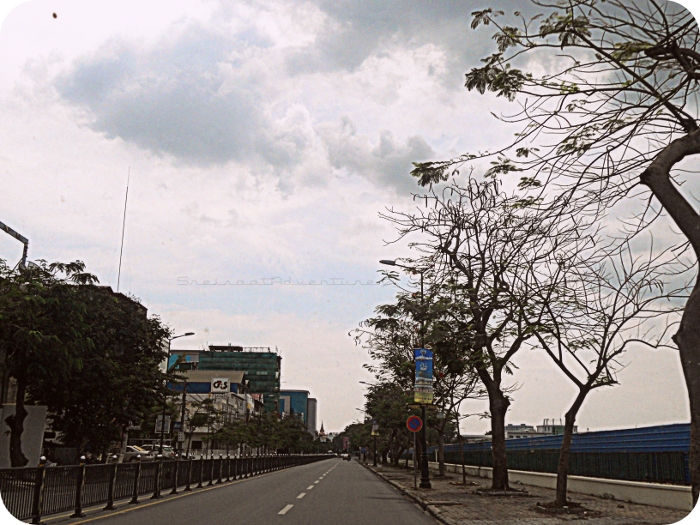
One lane at the Russian Boulevard, heading to the direction of Pochentong airport. Empty. I was so tempted to drive.
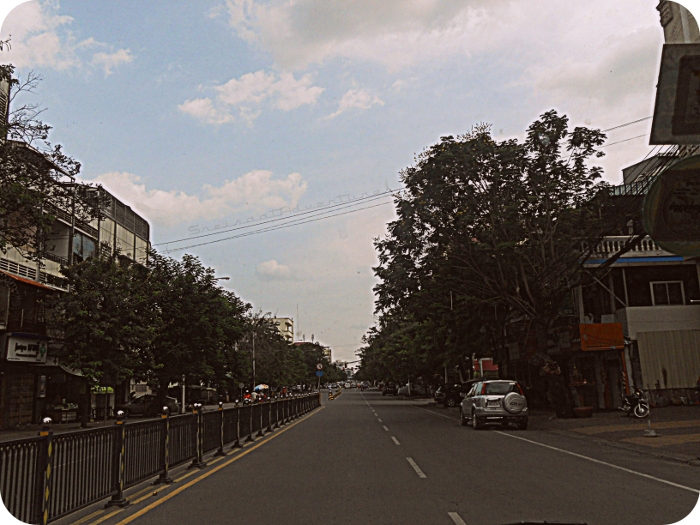
Here is the northern part of Mao Tse Tung Boulevard, several metres off the Russian Boulevard-Mao Tse Tung intersection. One can see the through the long road.
APAD 116: Summer rain
Yesterday, we finally had rain after several weeks of extreme heat.
The rain was strong enough, with a bit of wind, too.

Having had 38Cs in the past weeks, this is really a welcome change. A cool relief from PhnomPenh’s summer heat. This is probably the first big rain in a long time… six months, more or less, if I am not mistaken.
Just 30mins of rain and our street is already flooded. Why? Because some genius cemented the drains. Drat.
APAD 111: Temple guardian
I’ve always been fascinated by different mythical creatures and deities and living here in Cambodia doesn’t disappoint. These creatures are present in Khmer culture.
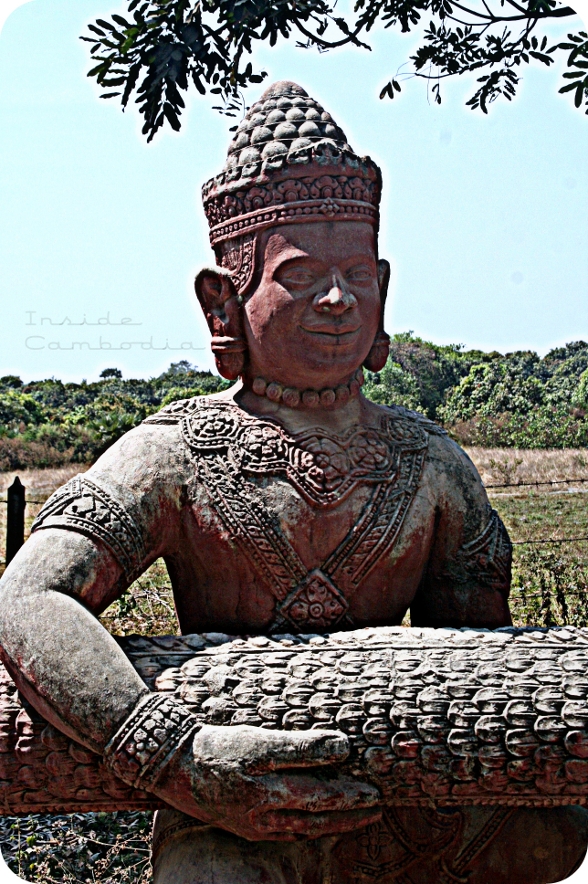
This is a temple guardian called, or a dvarapala. And it’s only one of the many other dvarapalas that adorn in most Khmer temples. Another kind of dvarapala is found here.
APAD 107: Life in the countryside
Just sharing another picture of rural Cambodia. I took this during one of our previous road trips last month.

On the way to Phnom Oudong (background), an old man and his cow.
Turning into this dusty road on the way to Phnom Oudong, we drove slowly following this old man, walking barefeet. My husband was driving slowly, carefully, so as not to stir the red, sticky dust and envelope the old man it. With the stifling heat at that time, I was amazed at how he went about his chore. When we passed him by, I rolled the window down and politely said, “chum riep soo, lok ta.” Hello, grandpa. My husband chimed in, in perfect timing.
Lok ta turned his head to us and smiled, broadly revealing a toothless mouth. From what I saw, lok ta looked genuinely surprised and pleased at a barang‘s (foreigner’s) greeting in his own language. “Baa, okun”. Thank you, he replied. I asked him where he was going. He’s taking his wayward cow back to the herd a hundred metres away. And he went on his merry way.
I know this is just a random encounter but I wonder what was he thinking afterwards. Would he remember the day these two foreigners (us) stopped by and talked to him? What did he think about us? For sure, I’ll remember him and his toothless grin. I pray that he be healthy to be able to do his chores and that he be safe in doing so.
A Silver Finish!

Certified!



Follow Us!