


APAD 097: Mother and child
This statue can be found inside the huge Prasat Vihear Sour complex.




APAD 095: Funeral hearse
This is a funeral hearse commonly used in Cambodia.
The decors look Chinese and look how fancy and elaborate the details are – hues of gold, red and blue carvings of sbach pattern and amazing dragons on both sides of the vehicle.
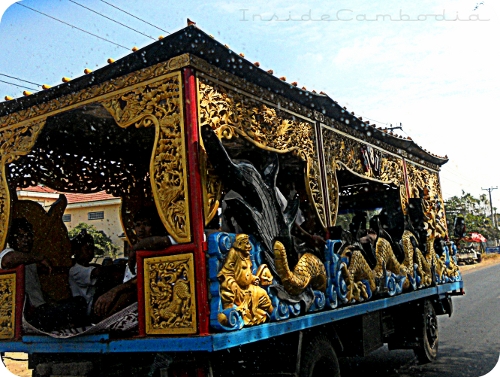
The vehicle overtook us at national road number five at a very fast speed. It was empty (no coffin, I mean) but only some people who are probably in-charge of the hearse. I reckon it’s probably running late for its appointment.

APAD 094: Isang Bagsak
This was one of the interesting and enriching projects my (former) team and I joined several years ago. It gathered government workers, NGO staff, community members, other communication practitioners, and members of the academe in selected Southeast Asian countries for a collaborative project of building capacities for participatory development communication relating to natural resources management. On the wall sign, it shows the different activities undertaken by the participating countries, namely, Cambodia, Vietnam and the Philippines.
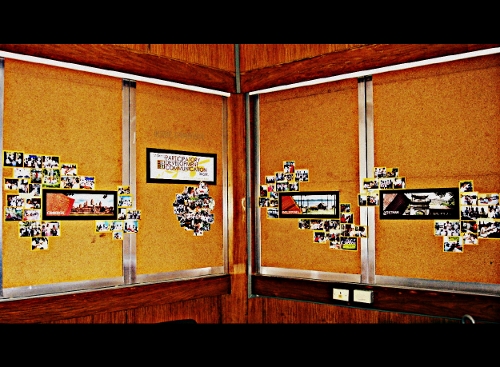
Isang Bagsak! Southeast Asia
The project was dubbed the Isang Bagsak Southeast Asia Project. Isang Bagsak is a Filipino phrase coined to describe a unity cry accompanied by one single and loud clap and stomp of feet to signify unity, agreement, and appreciation, among others. “Isa”, means one; “bagsak” means fall. I hope my explanation makes sense 😉 A similar project was also done in Africa.

APAD 093: Temple guardians
Saw this at the pond inside Prasat Vihear Sour two weeks ago.

If I am not mistaken these are temple guardians called “dvarapalas” or the mythical monsters called “kala”.
Either a “dvarapala” or a “kala”, they are the guardians of the temple and are decorative elements in Khmer architectures and structures.
APAD 092: Prasat Vihear Sour
I don’t exactly know what it means in English but this particular wat attracts numerous local and foreign tourists because its architectural style is based on that of the Angkor Wat. It is constructed using a mix of cement and cement between 1996 to 1998 to a whopping amount of — wait for it – about one million dollars. WHEW!

Prasat Vihear Sour does look like Angkor Wat, isn’t it? Which is why it has earned the nickname “the new Angkor Wat”.
The money used is said to have been raised from local and foreign sources.
We went there during the Chinese New Year and it was located inside a sprawling compound with lots of trees and shade. There are also other new but smaller structures, still bearing the same architectural style. It has also an amazing archway decorated with giant-faces just like the faces that are found in the temples of Bayon.


A Silver Finish!

Certified!



Follow Us!