

APAD 104: Another wat on a hill
In one of our previous trips to the countryside, my husband and I passed by this newly-constructed wat (temple) located just within the same area as Wat Phnom Oudong. This temple is called Wat Leu, if I remember it correctly. It sits on top of a hill on the other side of Phnom Oudong. “Leu” means top, hence, the wat‘s name which means the upper wat.

This is the new prayer hall in magnificent gold and maroon colours. The roof is decorated in ornate Khmer classical design, the kbach, and the five-headed naga, a mythical water serpent.
Here are some pictures we took while exploring the wat. Click the picture once to open it in a new tab. Once it opens in a new tab, click the picture again, if you want a larger view.
-
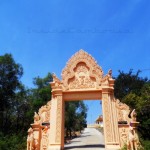
- The entrance to Wat Leu is guarded by these two solar lions.
-
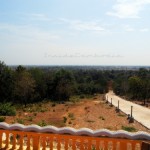
- Visitors are treated to a breath-taking view of rural Kandal.
-

- There is also some stone statues inside the premises, including that of Ganesha.
The temple although very new is a great place for taking photos. The beautiful flat countryside dotted with palm trees as far as the eyes can see. It is also very quiet and local villagers come here to seek peace and serenity if only for a few hours.




APAD 088: Temple-hunting
It was the Chinese New Year and my husband and I wanted to escape the city. We finally pushed through with our plan last Sunday. My husband, younger brother and I drove 30-40kms northwest of Phnom Penh and found ourselves heading to Phnom Prasith. There we spent the whole day temple-hunting (and kite-flying afterwards).
Despite the heat and the bumpy and dusty ride, we found what we were looking for, a pre-Angkorian wat (temple) – or what’s left of it, anyway – that sits on top of Phnom Prasith and tucked in the lush vegetation.

There’s just so much more temples to explore if only you are game enough to go off the beaten trail.
Since it is perched up a hill, it is cool, very quiet and offers an excellent panoramic view of the area. Local villagers come here often for their daily prayers and offerings to monks-in-residence. During special Buddhist holidays, such as the Khmer New Year and Bon Pchum Ben, the number of visitors increase as the villagers are joined by local tourists who’ve come to offer prayers and food to the monks and spirits of long-gone ancestors to earn extra merits for their next life.
Although we preferred exploring the area by ourselves but we also didn’t turn down the offer to be toured around by a villager. He really gave us interesting details about the area, for example, behind the altar (picture on the top right), is a tunnel about 16kms long and connects this wat to Phnom Oudong, the old capital of Cambodia (1618-1886) before it was moved to Phnom Penh.
Here are some more pictures:
-

- This side of the temple is being overrun by the vegetation.

-

- Details of the wall carvings.

-

- An altar between huge boulders is housed inside the ruin.,

-

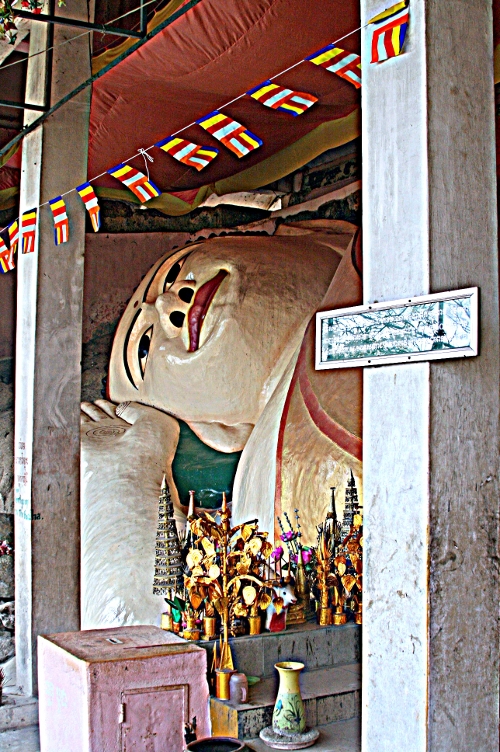
- Giant reclining Buddha, in the state of Nirvana.

-

- A close up view of the giant reclining Buddha.
-

- Eerie – a tree growing out of the wat.

-

- A very old stupa, a few meters away from the temple ruins.

-

- A relic lying on the ground.

-

- A Buddhist angel kneels in prayer.

Please click the individual photo for a larger view.
Don’t forget to come back next week. I will feature another wat. Not as old but equally interesting, too.
APAD 084: Signs of mourning
Yesterday, on the last day of the King-Father Norodom Sihanouk’s funeral, the whole capital of Phnom Penh stopped as the Cambodians paid their last respects to the King-Father. Nearly everyone was wearing black and white.
My husband and I didn’t dare venture to the riverside – where the Royal Palace and the Royal Cremation Pavillion are – since the day one of the funeral ceremony. While it is closed to the general public, there was a crowd of mourners there, day in and day out. Instead we drove outside the city last Saturday, to Oudong which was the ancient capital of Cambodia.
Along the way, we saw flags in half-mast lined up the roads. Some houses put up a small altar with a picture of the King-Father and candles and incense sticks in their yards. The local wats (temples), on the other hand, have set up a more elaborate altar open to anyone who wants to pray and pay their respects to the King-Father.
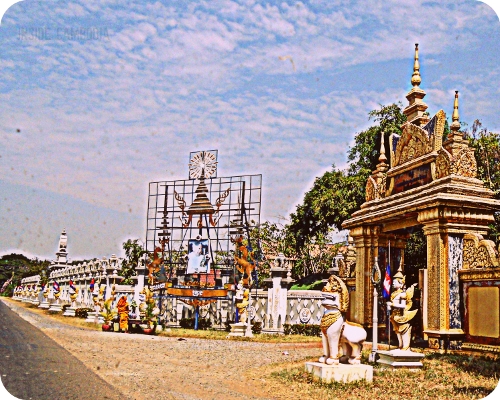
Half-mast flags and a roadside altar just outside a wat.
Here’s another altar outside a wat. Some people who could not travel to the city are encouraged to visit local wats such as above and below to offer their prayers for the King-Father.

Another altar, closer view.
The picture below shows a “ghost flag” flying over Wat Chey Oudom. The flag is in the shape of an “x-rayed body” and is usually displayed at the wats, or the house of the deceased, where a funeral ceremony is being held. For non-Buddhists, it’s like an RIP banner of sorts. In Buddhism, this “ghost flag” represents the soul moving on to the other world.

A ghost flag flies quietly, representing the soul of the deceased moving on.
Here is a fellow blogger’s account of the funeral ceremony, LTO Cambodia. He was fortunate to be able to go and see the funeral proceedings.
APAD 079: Overloaded
This is how we roll in rural Cambodia.

A jampacked taxi (van) and romorque and a moto.
When I used to work in one of the rural towns in the southeastern part of the country, the sight of jam-packed vans, pick ups and remorques (a motorcyle pulling a long cart) overloaded with goods and people is a common sight. With no transportation provided for project staff like me, I experienced squeezing myself and my luggage in an already full mini-bus. On some days, the overhead compartment were crammed with bags of rice and other produce, sometimes there were also live chickens tied together, or even a squealing pig or two bagged inside a sack, all on their way to the markets in Phnom Penh. Oh, one of the fun times I had back then.
A Silver Finish!
Certified!


Follow Us!