

>Photo Hunt #17: I Spy
>
Okay, I am posting my Photo Hunt entry this early to make up for last week. I was meaning to post one but somehow got lost amidst the weekend frenzy, plus I have friends visiting. This week’s theme, I have to say, is one of Photo Hunt’s most challenging themes. One of the PH participants suggested this theme for us participants to shoot a picture of something hidden for the viewer to find. So here’s my take:
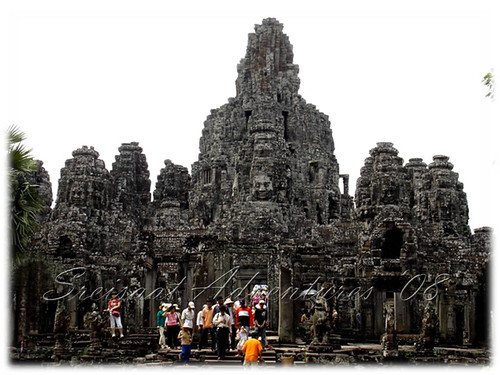
Go get your spyglasses or magnifying lenses and explore the picture a la Lara Croft of the movie, the Tomb Raider. Tell me what you can see in this picture. Can you make anything of it? Click the picture and select large size for your viewing pleasure 😀
I will post on Monday a close up of one of the spires.
Till then, ta-ta. Happy hunting, and have a great weekend!
Update:
The photo above is of the Bayon Temple, one of the popular temples inside the Angkor Wat complex. It was built in the late 12th century or early 13th century as the official state temple of the Mahayana Buddhist King Jayavarman VII. The Bayon stands at the centre of Jayavarman’s capital, Angkor Thom. From afar, as you can see in the photo above, it looks nothing but stones jutting out to the sky.
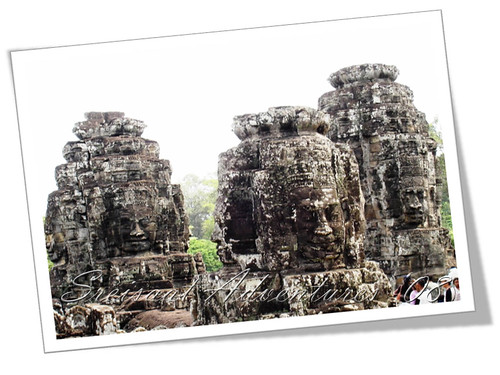
Click here for a larger view.
But up close, one is mesmerized by the mysticism and the enigmatic expression surrounding the images. Angkor scholars said that that the images have an uncanny resemblance to the King Jayavarman VII.

For those who might want to know more on the temples of Bayon, here’s a good starting point.

>Wordless Wednesday #32 – Apsaras and warriors of the Khmer empire
>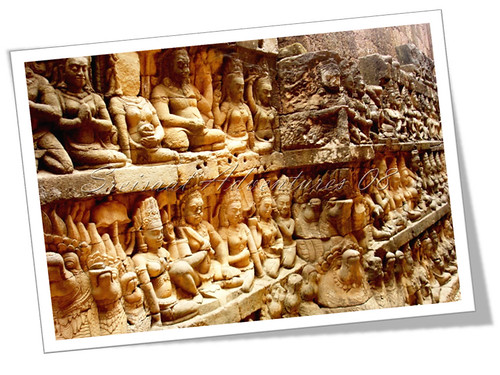
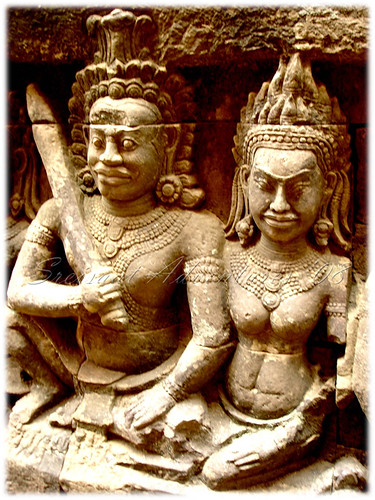
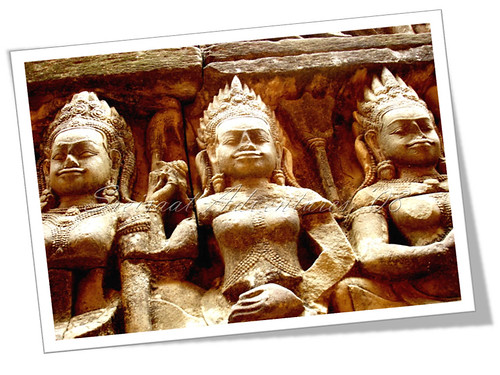
These stone carvings of apsaras and warriors are found in the walls and temples of Angkor. Apsaras are supernatural beings in the form of young and voluptuous young women and were said to be heavenly dancers. Click here to know more on the once-great Khmer empire.
More WW participants are found here.
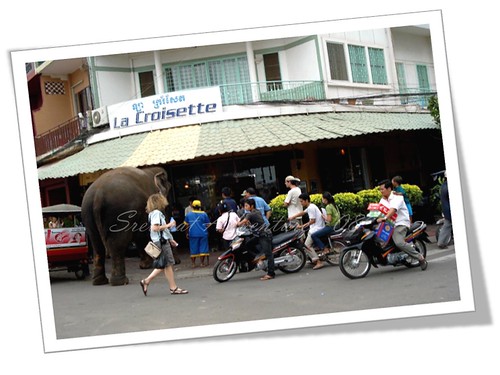
>Wordless Wednesday #31: Table for two, please!
>
Check out other fun photos at Wordless Wednesday.
>Photo Hunt #16: Street Party
>
This is the Ati-atihan Festival’s street party!
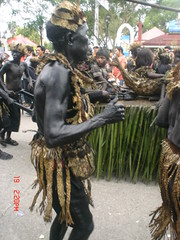
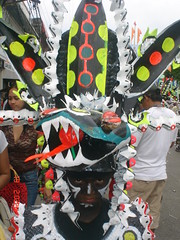
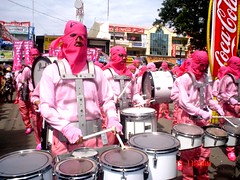
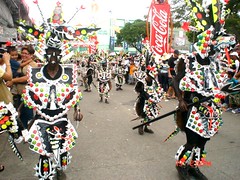
Thanks to my sister, MamaGirl, for providing me the photos. It’s been a long while since I last went home and I sure miss the merrymaking and celebrations there. Her story on the Ati-atihan festival can be found here, and more photos here.
>Photo Hunt # 15: Wooden
>
Hi guys. I am finally back again, and this time I am posting my entry for this week’s Photo Hunt. This week’s theme is “wooden”. It reminds me of the song “Wooden Heart” by the Bizarre Love Triangle in the 90s, if I am not mistaken.
But I digress now. Here is my take for this week’s theme:
The wooden cells of Tuol Sleng Prison:
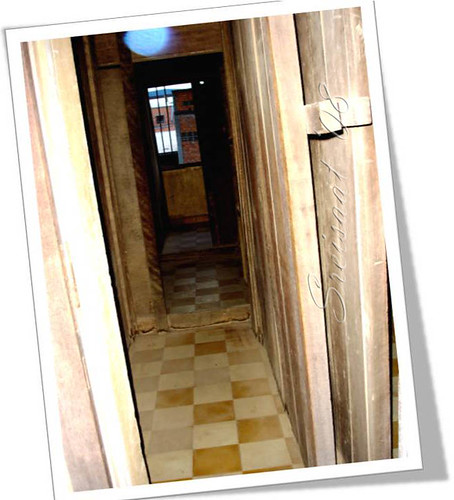

Tuol Sleng Genocide Museum used to be a high school in the 70s but was transformed into the infamous prison and interrogation center called the Security Prison 21, or S-21, during the Khmer Rouge regime in Cambodia. Classrooms were divided and made into crude prison cells (see above photo). Survivors of S-21 describe the horrors that they and countless others had suffered while in prison. Today, these wooden cells still bear signs of cruelty and torture; it stand as witness to the many atrocities committed by the Khmer Rouge. In my 8 years here in Cambodia, I have visited it twice, and that’s because my friends were here and I had to take them around. Visiting Tuol Sleng is not for the faint-hearted. Those who were brave enough to visit left with a heavy heart.
>Wordless Wednesday #29: Buddhism and Forestry
>
Check out other Wordless Wednesday photos.
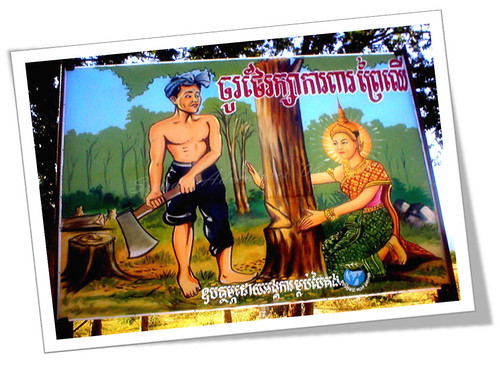
n.b.: Please excuse me, I know it is supposed to be wordless but I couldn’t help but explain the link between Buddhism, Cambodia’s religion, and the forests.
A lot of things has been said about the forests of Cambodia and one thing is for sure – the forests are rapidly disappearing with the country’s opening to a market-oriented economy. Here’s a section of what I wrote years ago:
Forest cover has decreased from over 70% in 1970 to around 35% today (depending on which source you are using), and many globally important mammals such as kouprey, tigers, and elephants are on the path to extinction. The forests, upon which local people depended for firewood, medicines, building materials, and religious or spiritual value, have been ruthlessly destroyed by logging companies.
Given the traditional prestige of Buddhist monks among the population and the natural ecological orientation of Buddhism as a belief system and way of life, monks are a prime target group for environmental education and awareness (EE) programs in Cambodia. They are capable of playing an important social role in guiding local populations in understanding, protecting, and improving the environment and in exerting moral pressure on those abusing the environment to change their behavior. A complementary relationship exists between pagodas (the wats and the watarams – the temples and their compounds) and their villages, instructing and providing guidance for the local populations on ethical and practical aspects of environmental protection, management, and enhancement.
To read more, you can find the whole post about my work with the Cambodian Buddhist monks here.
A Silver Finish!

Certified!



Follow Us!